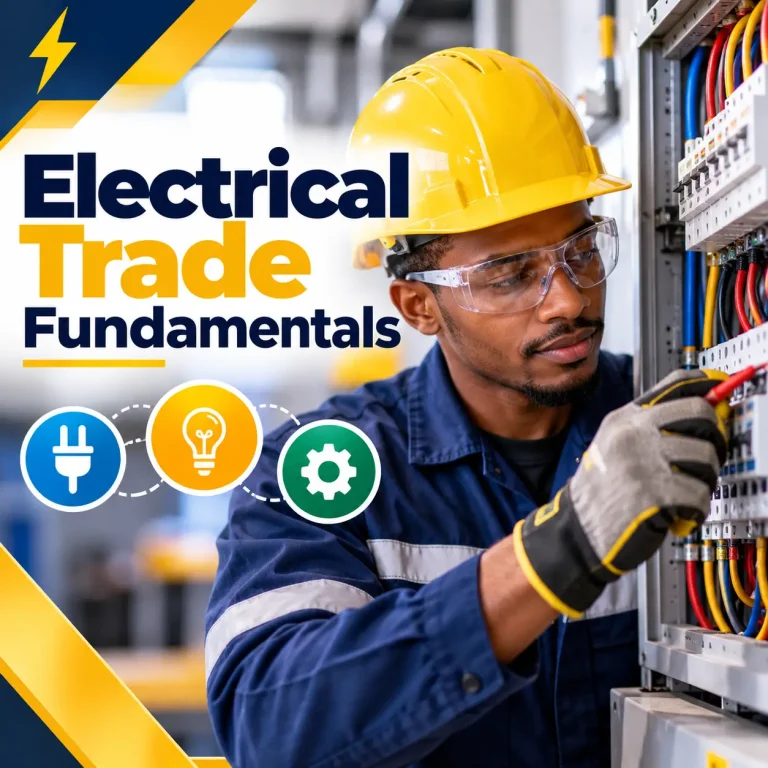
Study a Free Electrical Trade Fundamentals in South Africa with Durban City Academy. The Free Electrical Trade Fundamentals Course with Certificate in South Africa is an online beginner course for learners who want to understand the basics of...
The Free Electrical Trade Fundamentals Course with Certificate in South Africa is an online beginner course for learners who want to understand the basics of electrical trade work. Study circuits, components, tools, diagrams and safe working practices at your own pace, with a certificate available after completing the course.
It is suited to people exploring an electrical career, preparing for further training or building a practical foundation for workplace learning. You will study electrical quantities, supply types, common components, basic wiring methods, circuit protection, measurement and introductory fault-finding.
Electrical work combines practical skills with careful planning and attention to detail. This course introduces the ideas behind everyday electrical tasks so beginners can recognise common equipment and understand how circuits are put together.
Safety is part of the learning from the beginning. You will consider workshop conduct, personal protective equipment (PPE), hazard awareness and why electrical tasks require isolation and appropriate supervision. For general safety context, see these tips on preventing electrical shock hazards.
South African homes, businesses and industrial settings can use different supply arrangements. Learning the basic ideas behind single-phase and three-phase power can help you make sense of diagrams and equipment descriptions; this guide to single-phase and three-phase power offers a useful companion explanation.
Because the course is online, you can work through the material from home or another suitable study space. You can pause to review unfamiliar terms and return to key topics as you build confidence, while keeping in mind that online learning does not replace supervised practical training.
The lessons move from foundational concepts to practical workplace awareness. You will explore how current follows a circuit path, what common components do, how basic drawings communicate an installation and what to consider when preparing a simple circuit layout.
Practical topics include selecting familiar hand tools, preparing conductors, making secure connections and assembling basic circuits on isolated training boards. The course focuses on introductory learning rather than authorising learners to carry out electrical work independently.
You will also meet the basics of protective devices, earthing, bonding and safe measurement. A methodical approach to checking simple circuit symptoms can help learners describe what they observe and know when a fault should be reported or escalated.
After working through the learning material, you can use the completion certificate to record your learning as you plan further study. For more options across different subjects, explore EduCourse online courses.
Electrical knowledge is useful in many settings, from building and maintenance environments to workshops and technical training. A grounding in basic terms and equipment can make it easier to follow instructions, communicate observations and prepare for the next stage of learning.
This beginner electrical trade course gives you a structured way to explore the field before committing to more advanced study. It can help you identify topics you enjoy, build confidence with trade vocabulary and understand why careful workmanship matters.
Explore what electrical trade work involves, how workshop conduct supports safer learning and why tasks must be carried out within your training and supervision.
Meet voltage, current and resistance in practical terms. Learn how conductors and insulators behave and how current follows a complete circuit path.
Compare AC and DC fundamentals, series and parallel circuits, and introductory single-phase and three-phase supply concepts.
Identify the roles of switches, sockets, lamps, motors, cables and other common parts of basic electrical systems.
Review common hand tools, basic diagram symbols and how a simple layout can guide installation planning.
Learn about cable routing, support, protection, conductor preparation and secure connections, including assembly on isolated training boards.
Understand the basic roles of fuses and circuit breakers and how earthing and bonding contribute to protective measures.
Explore basic multimeter measurements, checking test leads and following safe procedures on de-energised circuits.
Consider common fault
Electrical Trade Fundamentals is designed for beginners who want a clear introduction to the subject, with practical lessons, guided learning, and simple explanations that are easy to follow online.
Yes, learners in South Africa can study this course online at their own pace, which makes it useful for flexible learning, personal development, and building practical knowledge from home or work.
This course covers practical learning areas such as What electrical trade work involves, Workshop conduct, PPE and hazard awareness, Why electrical work requires isolation and supervision, Voltage, current and resistance in practical terms, helping learners build foundational knowledge that can be applied in study, work tasks, and everyday digital learning.
Most learners can work through the course in a few focused hours, but the online format allows you to move at your own pace and revisit lessons whenever you need extra practice.
A certificate is available after successful completion, which gives learners a simple way to show that they finished the course content and assessment requirements online.
These skills are useful because they support workplace readiness, digital confidence, and practical day-to-day tasks, which can help learners strengthen their knowledge in a South African learning and work environment.